IP ONLINE JOURNAL
A Digital Library Collection
Phone No:+91-11-61364114, 61364115,
8826373757
Loading, please wait...
Phone No:+91-11-61364114, 61364115,
8826373757
| E-book Individual Original Price: | INR: 650.00 | USD: 40 |
| E-book Individual Offer Price: | INR: 390 | USD: 24 |
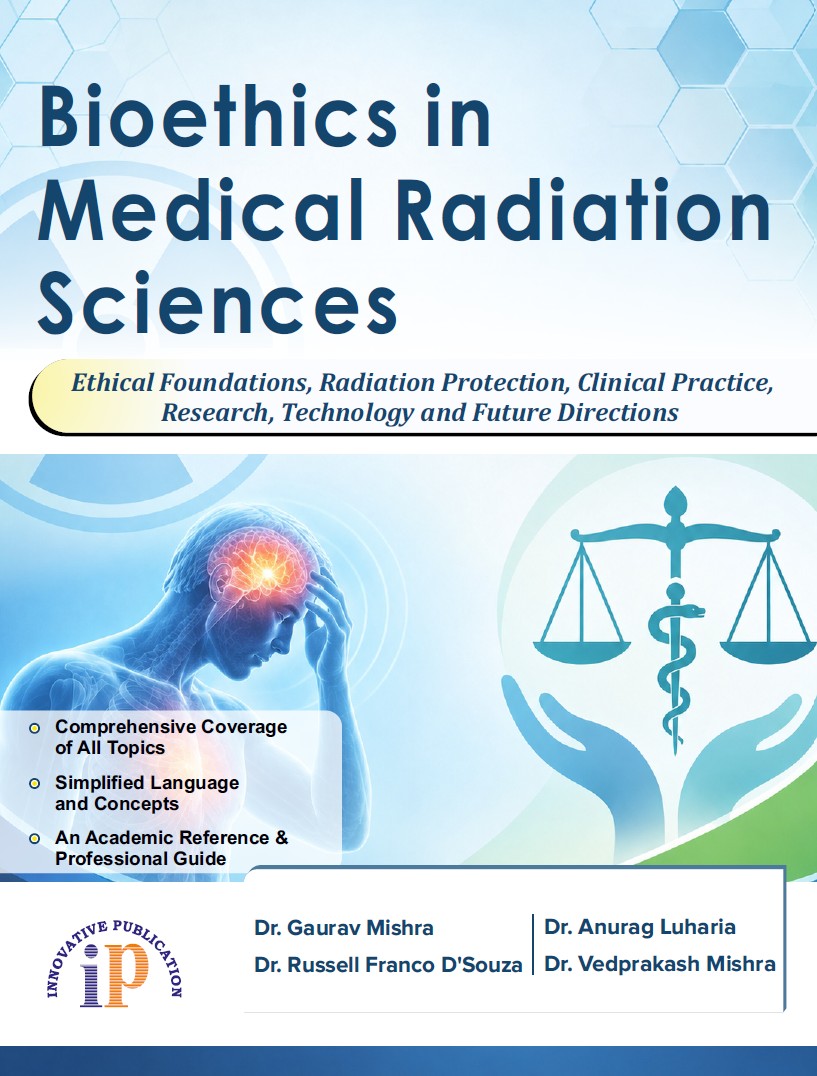
Bioethics in Medical Radiation Sciences has been developed in response to a rapidly changing clinical and technological environment in which radiation professionals must make increasingly complex decisions. The field now extends far beyond conventional imaging and treatment techniques, encompassing advanced radiotherapy, nuclear medicine, digital imaging, telemedicine, big data, artificial intelligence, precision technologies, and increasingly connected healthcare systems.
The central premise of this book is that ethical reasoning should be embedded in everyday radiation practice. The manuscript therefore brings together ethical theory, historical foundations, radiation protection, consent, confidentiality, clinical decision-making, research ethics, education, law, leadership, and emerging technologies. Across these areas, the four central principles of autonomy, beneficence, non-maleficence, and justice provide a recurring framework for analysis.
The book is organized into six sections. Section I establishes the foundations of bioethics, including ethical theories, the four pillars, and major ethical codes and declarations. Section II connects bioethics with medical radiation practices and radiation protection, with emphasis on ALARA, justification, optimization, dose limitation, informed consent, confidentiality, and data ethics. Section III examines ethical issues across diagnostic radiology, radiotherapy, and nuclear medicine. Section IV addresses contemporary and emerging challenges, including artificial intelligence, radiation research, ethics education, and medico-legal responsibilities.
Section V brings together case-based discussions, cultural and global perspectives, ethical leadership, and future directions. This progression allows the reader to move from foundational concepts to complex, real-world situations and then toward broader questions of professional identity, institutional responsibility, technological change, and the future of ethical radiation practice.
Finally, Section VI focuses exclusively on bioethics in medical radiation physics. It examines the fundamental scope and responsibilities of the medical physicist, the ethical imperative of riskbenefit balancing in radiation use, and the critical regulatory standards and international guidelines (such as those from the AERB, ICRP, and IAEA) that govern safe, ethical practice.
A deliberate effort has been made to keep the discussion relevant to multidisciplinary radiation teams. The ethical responsibilities of radiologists, radiation oncologists, nuclear medicine professionals, radiologic technologists, radiation therapists, medical physicists, researchers, educators, and institutional leaders are considered as interconnected parts of safe and humane healthcare.
The case-based material is intended to encourage reflection rather than provide one-line answers. Ethical dilemmas in radiation medicine frequently involve tensions between competing goods, uncertainty, time pressure, patient preferences, resource constraints, and professional obligations. The most responsible approach may therefore require structured deliberation, communication, consultation, documentation, and moral courage.
This book is intended for students, educators, clinicians, medical physicists, radiation safety professionals, researchers, administrators, and other healthcare professionals seeking a practical ethical framework for medical radiation sciences. It may also support curriculum development, continuing professional development, ethics discussions, case-based teaching, and institutional reflection.
If you are an individual seeking affordable e-books, please visit our publisher's website to explore our collection at discounted prices. Bioethics in Medical Radiation Sciences by Dr. Gaurav Mishra, Dr. Anurag Luharia, Dr. Russell Franco D'Souza, Dr. Vedprakash Mishra